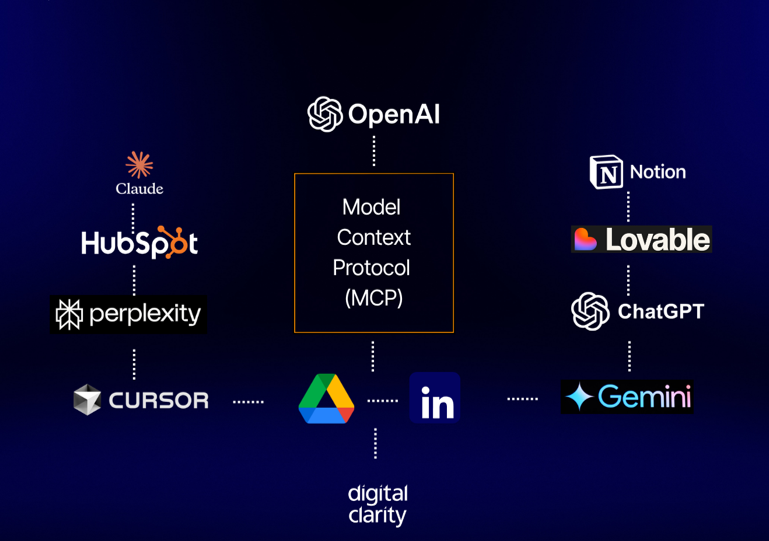
It’s no longer enough for large language models (LLMs) like ChatGPT or Claude to simply generate well-written email responses and create content. The future of enterprise AI is about context, execution, and action. That’s where Model Context Protocols (MCPs) come in: an open, elegant solution that turns AI models into connected, context-aware systems capable of operating across your tech stack.
In this article, we’ll explore what MCPs are, how they’re transforming GTM functions like marketing, sales, product, and strategy, and how you can start using them—including for experimental, creative coding approaches like vibe coding. We’ll finish with a guide to planning your organization’s MCP rollout.
A new operating layer for AI
As artificial intelligence moves from standalone tools to business-critical infrastructure, there’s a growing demand for AI to do more than just talk. Decision-makers now want AI systems that can:
- Access up-to-date customer data
- Take direct action in CRMs, CMSs, and analytics platforms
- Understand live business context
- Summarize relevant feedback from multiple systems
- Write, analyze, trigger, and optimize workflows dynamically
To unlock that level of utility, we need a layer between the AI model and the real world, a context engine. That’s where Model Context Protocols (MCPs) shine.
What is a Model Context Protocol (MCP)?
A Model Context Protocol (MCP) is an open standard and open-source framework that connects AI models with external systems, APIs, data stores, and live actions. It gives AI the ability to:
- Read from structured and unstructured sources
- Call external APIs or cloud functions
- Ingest custom context, rules, or prompts
- Trigger workflows (e.g., send an email, update a record, launch a script)
- Act as an autonomous agent inside your tool stack
MCPs make models context-aware, actionable, and adaptive—no longer limited to their training data.
Why MCPs matter more than ever
In the pre-MCP era, AI was limited to answering static prompts based on past data. It couldn’t access your CRM, update a dashboard, or tailor its behavior based on changing business inputs. With MCPs, AI becomes an extension of your business logic and operations.
They provide:
- Dynamic context (e.g., “Here’s the latest from Zendesk and Slack”)
- Operational execution (e.g., “Create this HubSpot campaign now”)
- Live intelligence loops (e.g., “Summarize all mentions of Feature X from the past 30 days”)
How to begin with MCPs
Getting started doesn’t require deep ML expertise or an army of engineers. Instead, you’ll need:
- A use case worth enhancing — Repetitive, manual, or data-heavy workflows are ideal.
- Data/tool access — APIs, file systems, or integrations your AI assistant can use via MCP.
- A model of choice — ChatGPT, Claude, Gemini, Perplexity, or others depending on the task.
Who can help?
Implementing MCPs can be a cross-functional effort. Involve:
- Product managers or owners — to define the business value and use cases
- AI/ML engineers or DevOps — to handle integration and security
- RevOps, GTM, or operations teams — to provide workflow knowledge
- Design and creative teams — for use cases like content, campaign building, or vibe-driven design
- External partners — consultancies, freelancers, or AI platform providers specializing in MCP architecture
How to devise a winning MCP strategy
Start small, plan big. A successful MCP rollout usually follows these steps:
- Identify high-friction workflows (manual, repetitive, insight-heavy tasks)
- Map your tech stack (what can the model connect to: CRM, CMS, docs, etc.)
- Prioritize live context sources (files, databases, tools)
- Define agent responsibilities (What should it read? Do? Monitor?)
- Prototype with a single team or department, measure impact, and scale
Real-world use cases: How MCPs transform GTM functions
Here’s where MCPs move from concept to game-changer. With MCPs in place, LLMs can unlock real, compounding value across go-to-market (GTM) functions.
1. Marketing: personalized campaigns at scale
Problem: Marketing teams struggle to personalize outreach at scale while syncing with real-time campaign performance.
MCP Solution:
Connect an LLM to:
- HubSpot or Salesforce for ICP and buyer journey insights
- Google Docs for collaborative messaging briefs
- Email platforms like Customer.io or Mailchimp
- Campaign performance dashboards via Looker or Mixpanel
Example prompt:
“Generate a reactivation email for B2B customers in EMEA who haven’t opened a campaign in 30+ days and match our enterprise segment. Use past subject lines that had >30% open rate.”
Impact:
Campaigns go out faster, more targeted, and continuously optimized using live data.
2. Sales: intelligent pipeline management
Problem: Reps spend too much time hunting for deal insights buried in tools.
MCP Solution:
Link an LLM to:
- Salesforce (deals, contact activity)
- Gong (call transcripts)
- LinkedIn Sales Navigator
- Internal Slack or Notion notes
Example prompt:
“Rank current pipeline by close probability based on intent signals, past engagement, and activity gaps. Suggest next steps for top 5 deals.”
Impact:
Reps sell smarter. Managers forecast more accurately. Deals move faster.
3. Product: synthesizing the voice of the customer
Problem: Feedback is scattered across tickets, forums, surveys, and calls.
MCP Solution:
Connect to:
- Zendesk (tickets, tags)
- Slack (#customer-voice)
- NPS and survey data
- Productboard or Jira for roadmap visibility
Example prompt:
“Summarize all mentions of ‘dashboard UX’ in support tickets and Slack over the past 60 days. Include top pain points, feature requests, and sentiment.”
Impact:
Better product decisions, grounded in live feedback.
4. Strategy & Ops: always-on competitive intelligence
Problem: Strategy teams rely on ad hoc research to track competitors.
MCP Solution:
Connect to:
- Web monitors (RSS feeds, product changelogs)
- Hacker News, TechCrunch
- Internal notes and SWOT docs
- Google Drive for shared research folders
Example prompt:
“Weekly summary of Competitor X: any product updates, major hires, blog posts, and social signals. Suggest opportunities or threats.”
Impact:
Faster strategic shifts with continuous awareness.
Creative application: MCPs and the rise of “Vibe Coding”
“Vibe coding” is an emergent development style where builders use LLMs not just as programmers, but as creative collaborators. It’s about coding with mood, emotion, aesthetic, and flow.
MCPs power vibe coding by allowing LLMs to:
- Read from your local design system
- Run, test, and refine code live
- Inject creative context (fonts, tone, images, motion)
- Build prototype flows and copy together
Example use case:
“Let’s build a landing page for an early-stage wellness app targeting Gen Z. It should feel like summer, with minimal copy and animated UI.”
MCP-enabled AI assistant does:
- Calls Figma API for layout
- Styles components with Tailwind
- Injects fonts and color palettes
- Writes microcopy in the brand’s voice
- Tests layout responsiveness in browser
Impact:
It’s not just faster prototyping—it’s creative alignment from the start.
How to prepare for MCP adoption
Checklist: What You’ll Need
- Identify one high-impact use case
- Choose an LLM (or multiple)
- Inventory your tools and their APIs
- Set up basic identity/auth layers
- Start with a test dataset or sandbox
- Track before/after metrics (speed, insight, revenue impact)
Tech Considerations
- Use open-source MCP libraries like LangChain or AutoGen
- Consider orchestrators like OpenAgents or CrewAI
- Ensure data governance, audit logs, and privacy rules
- Keep humans in the loop—especially in early stages
Conclusion: The age of actionable AI has arrived
We’re entering a new phase of AI adoption—one where models don’t just think, but also know, see, and do. Model Context Protocols are what make that leap possible. They turn LLMs into agents, deeply embedded in your systems, workflows, and context.
MCPs are not just a technical bridge—they’re a strategic unlock. Whether you’re a GTM leader looking to automate personalization, a product manager seeking real voice-of-customer insight, or a developer exploring creative AI flows, MCPs give you leverage.
The organizations that master MCPs early will outpace their competition—not by automating everything, but by intelligently enhancing the right things.
The future of AI is not about answers.
It’s about actions. And MCPs are how we get there.